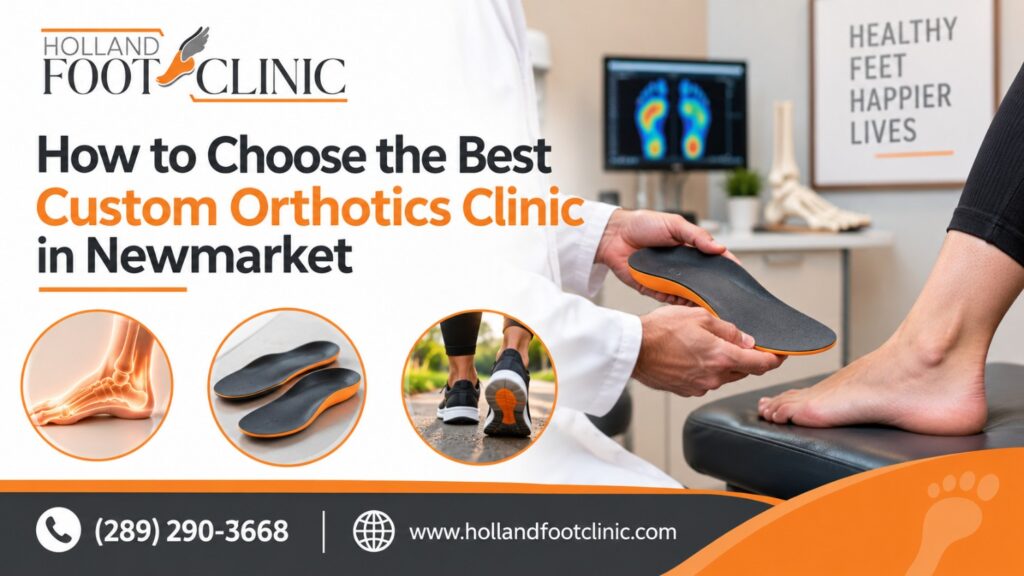
If your feet hurt every time you walk, run, work, or exercise, buying another pair of insoles may feel like the easiest solution.
But when foot pain keeps returning, the bigger question is often not “Which orthotic should I buy?” but “Which clinic can determine what my feet actually need?”
Searching for custom orthotics in Newmarket can bring up clinics offering digital scans, gait analysis, custom devices, and different types of foot care.
On the surface, many services can look similar. The important differences are often found in what happens before the orthotic is made and after you receive it.
A properly selected custom orthotic should not simply be shaped to your foot. It should be based on an appropriate clinical assessment, your symptoms, your movement, your footwear, your activities, and the goals of treatment.
So, how do you choose the right clinic?
1. Start With the Assessment, Not the Orthotic
One of the biggest mistakes people make is comparing clinics based only on the price or appearance of the orthotics.
The quality of the assessment matters first.
A thorough assessment may consider:
- Your current symptoms and medical history
- Foot structure and alignment
- Joint range of motion
- Weight-bearing foot position
- Walking or running pattern
- Lower-limb mechanics
- Current footwear
- Work and daily activities
- Sports or exercise demands
- Previous injuries or treatments
The reason is simple: two people can have similar symptoms but very different mechanical factors contributing to those symptoms.
For example, heel pain in a recreational runner may require a different approach from foot discomfort in someone who spends eight hours standing at work.
Likewise, an athlete who needs an orthotic for a running shoe may have different requirements from someone who needs one that fits inside a dress shoe, work boot or hockey skate.
Professional prescribing and dispensing custom foot orthoses depends on factors such as medical history, footwear, activities, and work environment.
2. Make Sure a Qualified Foot-Care Professional Is Involved
Technology does not replace clinical judgement.
A 3D scanner can capture the shape of a foot, but the scan itself does not determine what type of orthotic is appropriate. The clinician still needs to interpret the findings and determine what the device is intended to accomplish.
Custom foot orthosis production is a process involving clinical assessment, biomechanical examination, gait analysis, foot capture, design, and manufacturing. It also emphasizes the role of the assessing professional in controlling the design and manufacturing process.
When comparing custom orthotics Newmarket clinics, look for clear information about who performs the assessment and what their professional qualifications are.
For people seeking care from a chiropodist or podiatrist, Ontario’s professional standards provide a useful benchmark. The College of Chiropodists of Ontario specifically addresses the assessment, prescription, fitting, and education involved in prescription custom foot orthoses.
You should feel comfortable asking:
- Who will assess my feet?
- What professional designation do they hold?
- Will they assess my walking or movement?
- Will they explain why an orthotic may be appropriate for me?
- What happens if an orthotic is not the best option?
That last question is particularly important.
A reputable clinic should be willing to tell you when another treatment approach may make more sense.
Your Treatment Journey Starts Here
Book a consultation today and take the first step toward better care.
3. Look Beyond the Words “3D Scan”
Digital scanning has become increasingly common in orthotic care, and it can be a useful method of capturing the shape of the foot.
But 3D scanning does not automatically mean an orthotic is truly customized to your needs.
The more important question is what happens with the information captured by the scan.
The Pedorthic Association of Canada explains that foot capture is one stage of a larger process. The clinician’s assessment, biomechanical findings, and prescription guide the design and manufacturing of the orthosis.
A clinic that talks extensively about scanning but says little about the rest of the process deserves more questions.
4. Ask How Your Orthotics Are Designed and Manufactured
“Custom made” can sound straightforward, but there is considerable detail behind that phrase.
The prescription may specify factors such as:
- The intended correction or accommodation
- Materials
- Device thickness
- Modifications
- Cushioning or pressure relief
- Footwear requirements
- Activity-specific needs
The manufacturing process may involve traditional methods, CAD/CAM technology, milling, 3D printing, or other fabrication techniques.
The technology itself is not necessarily the deciding factor.
The better question is:
“Why is this particular design and material appropriate for my feet and my activities?”
Current Canadian guidance recognizes that custom orthoses should be designed around the patient’s clinical needs, footwear, and activities.
A clinic should be able to explain the reasoning in language you understand.
If the explanation sounds complicated but you still do not understand what your orthotics are supposed to do, ask for a simpler explanation.
5. Consider Whether the Clinic Understands Your Footwear
An orthotic that works beautifully in one shoe may not work well in another.
This is an often-overlooked part of choosing a clinic.
Your footwear can affect the size, shape, thickness, and design of an orthotic. Someone who wears running shoes throughout the week may need a different design from someone who wears safety boots, work shoes, skates or cycling shoes.
Some Newmarket-area clinics specifically discuss footwear, gait assessment and different applications for custom orthotics, which reflects how important footwear can be to the overall process.
Before your appointment, think about where you actually want to use the orthotics.
Bring the shoes you use most often if the clinic recommends doing so.
6. Ask What Happens After You Receive the Orthotics
Getting the orthotics is not necessarily the end of the process.
Your body may need time to adapt to a new device, particularly if it changes how pressure is distributed or how your foot moves.
Professional guidance for prescription custom foot orthoses includes patient education, instructions for developing tolerance, appropriate footwear guidance, and follow-up care.
That means you should understand:
- How gradually you should begin wearing them
- What sensations are normal during the adjustment period
- What discomfort should be reported
- When you should contact the clinic
- Whether adjustments are available
- Whether follow-up appointments are recommended
This is one reason choosing a clinic based purely on the lowest price can be misleading.
The real value of an orthotic service includes the assessment, clinical reasoning, device, fitting and ongoing care, not simply the physical insert.
7. Find Out About Adjustments and Follow-Up
Even a carefully designed orthotic may require an adjustment.
Your footwear may change. Your activity level may change. Your symptoms may change. You may discover that the device feels different after wearing it for longer periods.
A good clinic should have a clear process for dealing with these situations.
You should know whether adjustments are included, whether follow-up appointments are recommended, and whether there are specific conditions attached to any warranty.
Do not assume every clinic handles adjustments in the same way.
8. Compare Clinics Based on Clinical Fit, Not Just Price
Cost is naturally part of the decision, especially because custom orthotics may involve a significant out-of-pocket expense.
However, comparing clinics solely on price can leave out some of the most important variables.
Instead, compare the complete service.
| What to compare | Why it matters |
| Clinician qualifications | Helps you understand who is assessing your feet |
| Clinical assessment | Determines whether orthotics are appropriate and what they should address |
| Gait and biomechanical assessment | Provides information about movement and foot function |
| Foot capture method | Helps create an accurate representation of the foot |
| Prescription/design process | Connects clinical findings to the device |
| Materials | Should be selected for the intended use |
| Footwear considerations | Helps ensure the orthotic is practical |
| Fitting | Confirms the device works with your shoes and feet |
| Follow-up | Allows concerns or adjustments to be addressed |
| Insurance documentation | May help with reimbursement where coverage applies |
Current Newmarket clinics advertise a range of approaches, including 3D scanning, gait analysis, biomechanical assessment and different manufacturing arrangements.
That makes it especially important to compare the complete clinical process, rather than assuming that the most advanced-sounding technology automatically means the best care.
9. Be Cautious About Guaranteed Results
Be wary of promises that suggest custom orthotics will definitely eliminate pain, correct every alignment problem, or prevent future injuries.
Foot pain can have many contributing factors.
Orthotics may be one part of a broader management plan, but whether they are appropriate depends on the individual assessment.
Professional standards describe prescription custom foot orthoses as devices used to improve function and help manage pain or discomfort associated with particular foot and lower-limb problems. They also recognize that treatment is individualized.
A good clinic should discuss what the orthotic is intended to do, rather than promising a guaranteed outcome.
10. Check Your Insurance Requirements Before Your Appointment
Before committing to custom orthotics, check your extended health benefits.
Coverage can vary between insurance plans. Some insurers may require specific documentation, a prescription, or a particular type of regulated healthcare provider.
Some Newmarket clinics also advise patients to check directly with their insurance provider because coverage requirements vary.
Ask your insurer:
- Are custom foot orthotics covered?
- Is a referral required?
- Is a prescription required?
- Does the provider need a specific professional designation?
- Is there a maximum annual benefit?
- What documentation is required?
- Is there a specific claim form?
Doing this before your appointment can prevent unexpected reimbursement problems later.
What Are the Red Flags When Choosing a Custom Orthotics Clinic?
A clinic may not be the right fit if:
- You are encouraged to purchase orthotics before a meaningful assessment
- The clinic cannot clearly explain who will assess you
- Your footwear and activities are ignored
- The process is based almost entirely on a scan
- You are promised guaranteed pain relief
- There is no clear fitting or adjustment process
- You cannot get a straightforward explanation of the cost
- Follow-up care is unclear
- You are pressured to purchase immediately
None of these points alone necessarily tells you that a clinic provides poor care. However, they are good reasons to ask more questions before making a decision.
Do You Always Need Custom Orthotics?
No.
Custom orthotics are not automatically the right answer for every person with foot pain.
Depending on the underlying problem, management may involve footwear changes, activity modification, exercises, stretching, strengthening, other forms of foot care, or another treatment approach.
That is why the assessment comes first.
The goal should not be to find a clinic that sells orthotics. The goal should be to find a qualified professional who can determine whether orthotics are appropriate and, if they are, what type of device makes sense for your individual needs.
Frequently Asked Questions
How do I choose the best custom orthotics clinic in Newmarket?
Look for a clinic that provides a thorough clinical assessment before recommending orthotics. Consider the clinician’s qualifications, gait and biomechanical assessment, foot measurement or scanning method, prescription process, manufacturing quality, footwear considerations, fitting and follow-up care.
Is a 3D foot scan enough to make custom orthotics?
Not by itself. A 3D scan captures information about foot shape, but a custom orthotic should be connected to clinical findings and an individualized prescription. Canadian guidance describes assessment, biomechanical examination, gait analysis, and clinical input as important parts of the process.
Are custom orthotics better than store-bought insoles?
They serve different purposes. Store-bought insoles may provide general cushioning or support, while prescription custom orthoses are designed around individual clinical needs. Whether custom orthotics are appropriate depends on the person’s foot condition, symptoms, activities, and assessment.
What should I bring to a custom orthotics assessment?
If the clinic recommends it, bring the footwear you use regularly, particularly the shoes associated with the activity or symptoms you want the orthotics to address. It can also be helpful to know your current medications, relevant medical history, and previous treatments.
How long does it take to get custom orthotics?
The timeframe varies according to the clinic, laboratory, manufacturing method, and type of orthotic prescribed. Ask the clinic about the expected timeframe before ordering.
Will custom orthotics feel comfortable immediately?
Not necessarily. Your feet may need time to adapt to a new device. A clinic should explain how to introduce the orthotics gradually and what to do if you experience unexpected or persistent discomfort.
Are custom orthotics covered by insurance in Ontario?
Coverage depends on your individual extended health benefits. Check your plan before ordering and ask the clinic what documentation it provides for claims.
The Best Orthotics Clinic Is Not Necessarily the One With the Most Technology
When searching for custom orthotics in Newmarket, it is easy to focus on scanners, materials, turnaround times, or the appearance of the finished device.
Those details matter, but they are only part of the picture.
The more important question is whether the clinic can connect your symptoms, foot mechanics, activities, and footwear to a sensible treatment plan.
A quality custom orthotic should be the result of clinical reasoning, not simply a scan of your feet.
At Holland Foot Clinic, our approach to custom orthotics begins with that bigger picture.
Our registered chiropodist team provides individualized foot assessments, biomechanical and gait assessments, 3D foot scanning, and custom orthotic fitting based on your specific needs.
Get an assessment from Holland Foot Clinic and explore your options to make an informed decision about your foot care.